

Each May 3rd we remember the Great Fire of 1901, not just for the scope of the devastation, but for the resilience of the city’s people.
There are so many parts to the story: the people, the physical devastation, the lack of necessities, the courage of the city to rebuild, the help from outside sources, the stories written by people who survived the fire and how it affected them. While most of the city of Jacksonville was destroyed, the Eastside was spared. When the fire reached Hogan’s Creek, it turned and spread south to the St. Johns River, and this is why Old St. Luke’s Hospital, the James E. Merrill House, and Old St. Andrew’s Church are still standing, among the few downtown buildings that survived the fire.
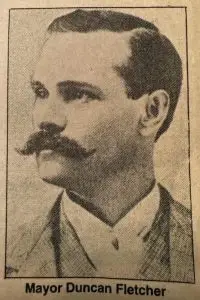
Seven months after the fire, the business community set out to rebuild Jacksonville as quickly as possible. In December 1901, newly elected Mayor Duncan U. Fletcher was asked about the new city construction. He described how there was no time to stop to talk or write and everyone was busy. In the early morning hours, you could hear the saws and hammers, and the work continued into the night.
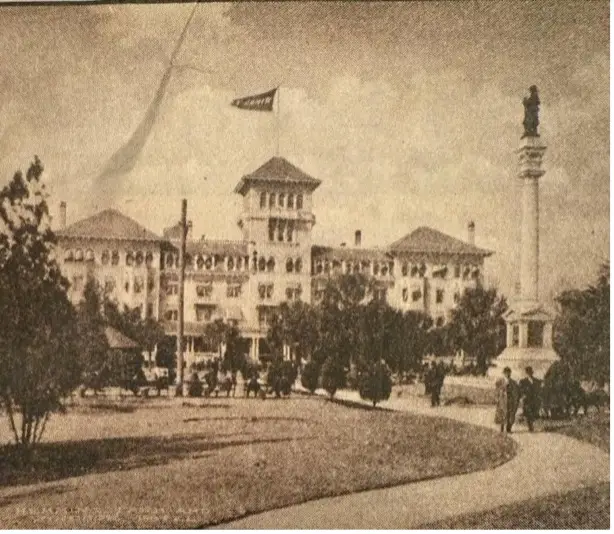
The Metropolis newspaper gave accounts of the numerous buildings being built, among them the Windsor Hotel (shown below), the largest and finest building. Erected on its old site on Hogan Street between Duval and Monroe streets, the hotel was five stories high, 210 feet square, and cost $315,000. The hotel re-opened January 15, 1902, with Mrs. A. R. Dodge and Frank T. Cullen as proprietors. The main roof was Spanish tile, admired on the Flagler hotels.
The Windsor Hotel was equipped with electric elevators, telephones in the rooms, steam heated, hot and cold water in the rooms. Every suite of two to four rooms had a private bath, with toilet and lavatory. Mrs. Dodge and Mr. Cullen ordered the furniture, linens, bedding, silverware, china, and kitchen furnishings.
On the northwest corner of Main and Bay streets was a four-story stone and brick building, which would be occupied by Furchgott & Co. This was at a cost of 40,000. Another building by D. B. Gardner, on the north side of Bay Street between Main and Laura Streets, was divided into two two-story stores. The west store, was occupied by the Greenleaf and Crosby Company, leading jewelers, while the Cohen Brothers department store occupied the east building. $40,000. Another building by D. B. Gardner, on the north side of Bay Street between Main and Laura Streets, was divided into two two-story stores. The west store, was occupied by the Greenleaf and Crosby Company, leading jewelers, while the Cohen Brothers department store occupied the east building.
Months after the fire, the real estate firm of Stockton & Budd had a large number of important deals involving a large amount of money. Telfair Stockton was one of the most successful real estate men in the South.
William Byrne, a wealthy and successful businessman, rebuilt his Main Street block. The Atlantic, Valdosta and Western Railway bought big business blocks two and three stories high in the East End. The cost of the new complex, on the north side of East Bay Street, was more than $250,000.
W. N. Emery was one of the largest property owners in Jacksonville and the heaviest loser. He erected a three-story block on West Bay Street and was in the shoe business again. The Emery block, at the intersection of Bay and Laura, was $30,000. After the fire, William A. Bisbee built several residences and began the construction of a modern business block on the corner of Laura and Bay streets, and it contained four stores.
J. H. Durkee, one of Jacksonville’s wealthiest citizens, built a modern business block on the corner of Newnan and Bay Streets. John G. Christopher built a block on the south side of East Bay Street (east of Liberty Street), which was the home of his ship supply and machine business.
The Dyal-Upchurch block, southeast corner of Bay and Main Streets, became a five-story stone structure, making this an office building.
The names and the buildings still have meaning in this city. Rebuilding was not questioned when looking at the devastation and suffering of the people of Jacksonville. The ashes were the reminder of what the city was. This rebuilding to make a better Jacksonville as soon as possible began the next morning.
(Information for this story was sourced from the Jacksonville Journal 100th Anniversary Edition written by James R. Ward, staff writer.)
Nancy Gandy | Merrill House Museum Coordinator