

A country needs a national narrative, and the United States of America has long identified its “brand” as a place of opportunity. That identity is sometimes expressed as the “American Dream,” where anyone can live up to their potential and achieve all that they are capable of. America’s founding document states that every man has an unalienable right to life, liberty, and the pursuit of happiness. Note that we have a right to pursue happiness – achieving it is optional. Life and liberty remain elemental to the American promise, though. What we do with them is up to us.
A city also needs a narrative. Is life in Jacksonville an experience that allows us hope for its future and for our own? In this 250th year of America’s experiment with independence, it’s worth considering whether cities such as ours are faithful to the foundational idea of America as a place where its people can flourish.
The answer used to be, “It depends.” One hundred twenty-five years ago this year, following the Great Fire of 1901, people flocked to Jacksonville because they saw it as a city abundant in its opportunities. The 1901 Fire was fabulously destructive, but people with vision, energy and ambition found encouragement and excitement in that. Jacksonville lit up with entrepreneurial fire, fueled by new ideas and innovations in technology, architectural design, engineering and construction techniques. Architects, builders, bankers and investors flocked to the city that seemingly offered a blank canvas for invention, and in the three decades after the Great Fire the city’s skyline changed entirely, while its population soared.
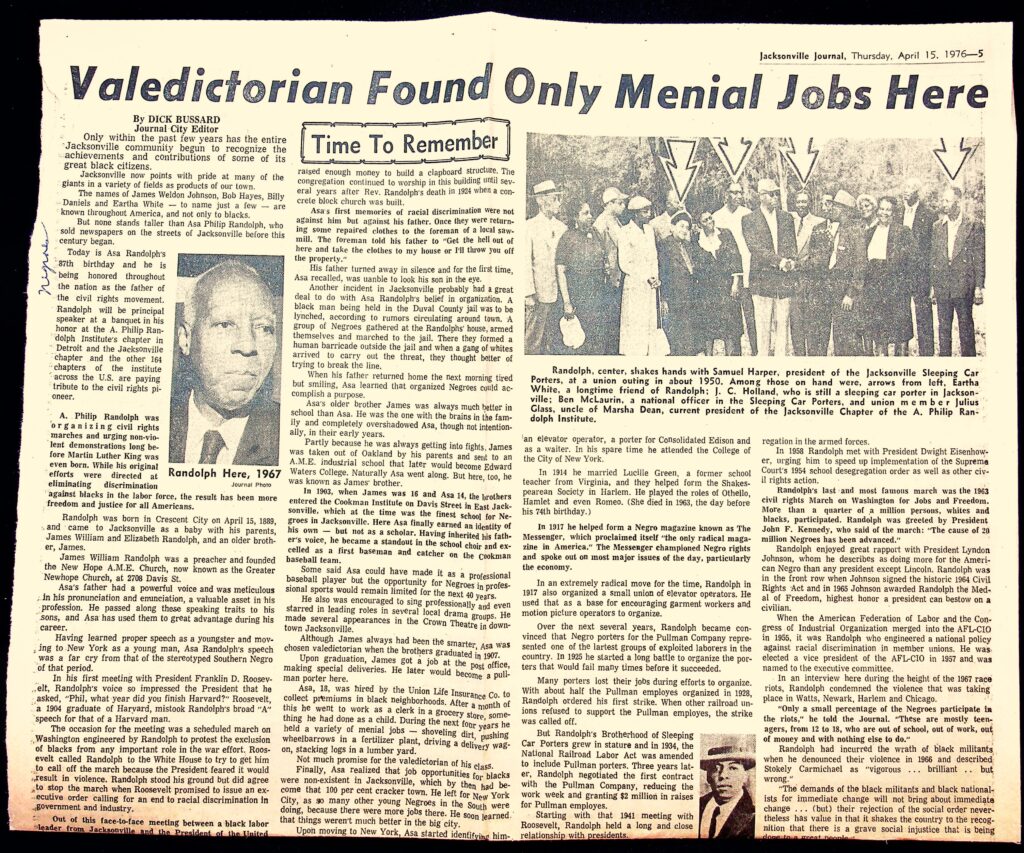
A young Jacksonville citizen during those same years, Asa Philip Randolph, had grown up in the city’s Oakland section, now part of the historic “Out East” community. To the young Randolph, born in 1889, the Great Fire was a formative event that marked the end of old Jacksonville and the beginning of new Jacksonville. The youngest of two boys raised by a tailor and part-time AME church minister and his wife, Asa grew up nurtured by literacy, discipline, and education. Beginning in 1903, he and his brother James attended the Cookman Institute, newly rebuilt after the Great Fire. The Cookman had been founded in 1872 as the first academic institution in Florida for African Americans. Asa was valedictorian of his 1907 graduating class, but in the four years that followed he came to realize that Jacksonville offered little opportunity for an educated young Black man. In 1911, Randolph left Jacksonville for New York, and there found his calling as well as the woman he would marry. A. Philip Randolph became the most important civil rights leader in 20th century U.S. history.
In the 21st century, Jacksonville’s young women and men are imagining their futures and wondering whether this is where they will discover their own gifts and find their callings. Jacksonville’s challenge is to be a place whose high school graduates see as worthy of their potential, whatever form that potential might take or wherever it might lead. If Asa Philip Randolph had seen Jacksonville in that light in 1911, the direction of American history might have changed and so might that of his hometown. The narratives of Black History Month would be different as well. Randolph’s story is well known, though he remains somewhat invisible in Jacksonville. Remembering his journey reminds us all to be mindful of what a city must be if it is to live up to its potential. It must continue to be a place that is brightened with abundant opportunities, where anyone can achieve what they are capable of.
Alan J. Bliss, Ph.D. | CEO, Jacksonville History Center