

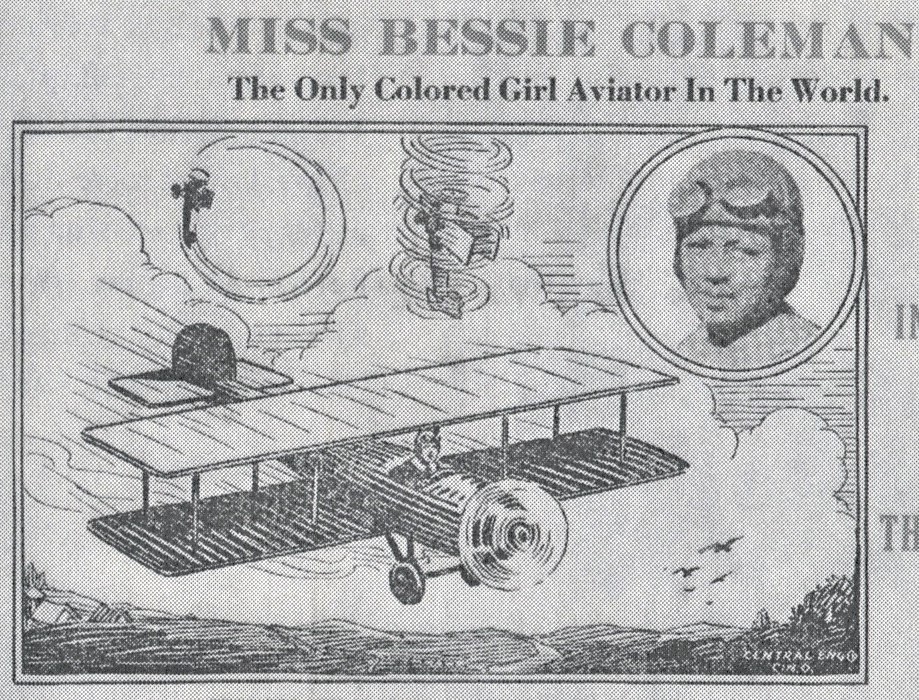
The life and tragic death of Aviator Bessie Coleman is a story that would certainly check the boxes for Black History Month and Women’s History Month, along with the box for Native American Heritage Month.
Bessie Coleman was the first person of color (male or female) to hold a pilot’s license from a recognized credentialing organization. Coleman earned her license from the Fédération Aéronautique Internationale on June 15, 1921. Coleman was also the first native American with that distinction, as her father’s grandparents were members of the Cherokee Nation.
It is noteworthy she accomplished this before Charles Lindbergh or Amelia Earhart came along, said Marks Gray, P.A. attorney and partner Edward M. Booth, who was the first attorney in Florida to become Board Certified in Aviation Law by the Florida Bar.
After learning that a death certificate becomes a public record 50 years after that person’s death, Ed Booth went to the Florida Office of Vital Statistics on Pearl Street and obtained a copy of Coleman’s death certificate and also looked for a copy of the death certificate for the pilot who delivered the plane from Texas the day before and was flying it while Bessie was in the rear seat, becoming familiar with the layout of the airfield. Vital Statistics could not find a death certificate on file for William Wills; however, he perished on impact after Bessie was thrown from the plane when the elevator controls jammed. Wills, also a mechanic, had left a wrench in the tail of the airplane. Bessie’s death certificate lists her occupation as “aviatrix,” well before female pilots were recognized.
Thursday April 30, 2026, is the 100th anniversary of Bessie Coleman’s death, the first person killed in an aviation accident in Jacksonville. Bessie Coleman, then 34, spent the last three days of her life, April 28-30, in Jacksonville preparing for an airshow and lecturing at several public schools. Sadly, an event to honor Bessie had been planned for May 1 by the Elite Circle and Girls DeLuxe Club. The program, called “An Aerial Frolic,” was to be held at the Pythian Auditorium, with music by the Jacksonville Jazz Orchestra. Instead, there were two funerals held in Jacksonville for Coleman, as well as one in Orlando, and the last one in her hometown of Chicago.
Then she was lost to history, claimed Booth. “Aviation history books published after her death did not mention her.” She was rediscovered in the 1980s and her story is now well known. In 1985 she was honored with a U.S. Postal Stamp, and the main entrance road to Chicago O’Hare International Airport was renamed Bessie Coleman Boulevard.
Ed Booth would like to have a suitable memorial commissioned in Jacksonville for Bessie Coleman. “I suggest a public school should be named after her, given the last days of her life were spent here speaking with students about her life and the obstacles she overcame,” said Booth, who has spent the past 40 years researching this amazing woman. More information about Bessie can also be found on FindAGrave.


Kate A. Hallock | Chief of Staff