

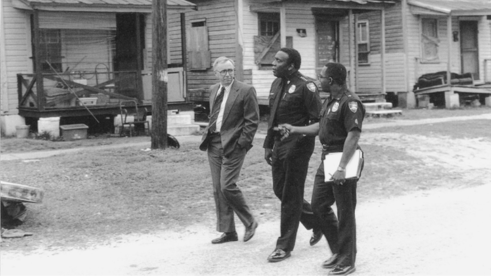
 On the afternoon of Sunday, August 16, several dozens of family and friends gathered at the Jacksonville History Center to celebrate the life of Harry S. Reagan (1938-2026). Harry passed away on July 23, a few weeks before his 88th birthday.
Holding the celebration for Harry at the History Center was appropriate. For one thing, he had already planned to be here with us on that day for his own birthday party, organized by his daughter Denise. For another thing, Harry was an historic figure in his own right – for 23 years a popular local TV broadcast journalist, then a civic leader who won election twice, serving nearly six years as a Jacksonville City Council member. In 1995 he resigned from the Council to run unsuccessfully for mayor of Jacksonville.
Harry Reagan arrived in Jacksonville in 1967, just as the countywide campaign for consolidation was reaching its climax. Bitter controversy and political bargains flew thick in Jacksonville’s public discourse that year, and no doubt fueled Harry’s natural instinct for journalism. But his new job, at Channel 4 / WJCT (now News4JAX), was as the station’s editorial director. This was at a time when local television stations broadcast the news and, in a carefully partitioned segment, also produced opinion pieces that stated the broadcasters’ position on issues of the day. Harry created and announced those position statements on the air, after the evening news. In other words, it became Harry’s job to have opinions and to publicly defend them, soon making him widely known in Jacksonville.
As a member of the City Council, Harry supported ideas that he believed would improve the City’s unique form of consolidated government. An issue that really mattered to him was a proposal to amend the City Charter to make local elections “unitary.” What that meant was that candidates could continue to file for office and campaign as Democrats and Republicans (or any other party), but every voter could cast a ballot for any candidate for local office. Put differently, there would no longer be a Republican primary election, nor a Democratic primary election. In a unitary election, the first round of voting eliminates every candidate except the top two. If neither of those two wins over 50% of the vote, a runoff election decides the winner. However, in the initial round of voting, it’s possible for one candidate to take 50% or more of the vote and be declared the winner.
A unitary election is different from a nonpartisan election. In a unitary election candidates are listed on the ballot according to party affiliation. In any given race, there may be as many candidates as there are people who qualified to run, and more than one may belong to the same party. As to voters, everyone who chooses to cast a ballot gets to vote in every race, no matter what party, if any, the voter is registered as. Democrats can vote for Republicans, and vice versa, and no-party-affiliation (NPA) voters have as much say as anyone else.
In November of 1992, the voters of Duval County voted to amend the Charter to allow unitary elections. The margin in favor of revising the Charter was 73% to 27%, and the change took effect in the 1995 local election. Harry campaigned for the amendment, arguing that it would stimulate voter participation. He may have believed that it would open up new opportunities in a citywide race, which is what he chose to pursue next.
Jacksonville’s 1995 mayoral election resembled something like a free-for-all. The incumbent mayor, Ed Austin, had decided against running for a second term, and no fewer than six candidates filed to succeed him. Three were Republicans – John Delaney, Steve Irvine and A.P. McIlwaine. The remaining three candidates were Democrats Jake Godbold (himself a former mayor), Tommy Hazouri (also a former mayor) and City Council member Harry Reagan. This first test of the unitary election rule produced a thrilling race that ended with Jake Godbold and John Delaney in the lead, but almost neck and neck, and neither with a majority. Godbold won 32.74% of the vote, and Delaney won 32.42. Four weeks later, the general election served as the runoff, which John Delaney won with 50.95% versus Jake Godbold’s 49.05%. Delaney became Jacksonville’s first Republican mayor since the 19th century, and served two full terms, running unopposed for reelection in 1999.
Harry Reagan polled at 10.68% in that 1995 mayoral primary and never ran for office again. However, he counted the adoption of the unitary election among his civic achievements. He advocated for other measures such as the elimination of vehicle tolls on the Mathews Bridge and improving Jacksonville’s air quality. He was a founder of the Jacksonville Broadcasters Association, which continues to meet at the Mudville Grille, and he became a board member, and later board chair, of the then Jacksonville Historical Society (now the Jacksonville History Center), where he (and his wife Rita) strongly supported historic preservation. In 2018, the 50th anniversary of Jacksonville’s consolidated government, he was at the table for every meeting of the commemoration task force, earnestly debating the merits and misfires of Jacksonville’s unique local structure. The through line of Harry Reagan’s civic philosophy was democracy, with a small “d.” He supported measures that empowered the public and encouraged voting. Plenty of Harry’s political contemporaries disagreed with him, and he with them. But the universal verdict on Harry as a public servant is that he respected differences and could argue his position with tolerance for those who spoke against him. He was a citizen, a statesman and a servant leader. Thanks, and peace, Harry.
Alan J. Bliss, Ph.D. | CEO, Jacksonville History Center