

A new book by historian Peter Fritzsche has been getting a lot of buzz. The title, 1942: When World War II Engulfed the Globe, sums up his research, narrative and argument – that 1942 was the climactic moment when war swept everyone and everything before it. The events of that year cast worrisome shadows over the future. We know how WWII ended, but in 1942, the outcome was an open question. All anyone could say was that worldwide conditions were awful, the future appeared dark and things were likely to get worse before getting better, if they ever would.
World War II had begun in 1939, and to the people of Jacksonville, as to most Americans, it was then a distant abstraction. For over two years, the armies and navies of the Axis Powers were locked in mortal combat in Europe, North Africa and in Asia. Far at sea in the Atlantic, ships torpedoed by German U-boats made national news. But the war’s effects on Americans were mainly economic, and in that sense, they were good. Southern seaport cities like Jacksonville had the capacity to build seagoing ships, and this city and others across the U.S. had been enjoying a wartime boom without the actual war.
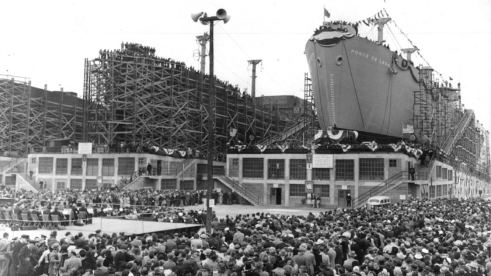
On December 7, 1941, all that changed with a surprise attack by the Japanese Navy on the U.S. Naval base at Pearl Harbor, in the Territory of Hawaii. The United States immediately shifted all its economic resources to war production. Beginning in 1942 in Jacksonville, that meant a radical increase in shipbuilding, a labor-intensive business that resulted in massive in-migration from rural areas, population growth and a housing shortage. The St. Johns River Shipbuilding Company, established by local shipbuilder Merrill-Stevens Company, would launch 82 Liberty ships from Jacksonville in less than 3-1/2 years.
On the night of April 10, 1942, the war came vividly home to Jacksonville, when the German submarine U-123 torpedoed and sank the tanker SS Gulfamerica within easy sight of Jacksonville Beach. The federal government was already rushing to completion two new local naval bases, Naval Air Station Jacksonville, and Naval Station Mayport, as well as a network of smaller nearby naval aviation training fields at places such as Whitehouse, Keystone Heights, Green Cove Springs and DeLand. That wartime construction boom boosted the fortunes of local firms such as Duval Engineering and Contracting, headed by George H. Hodges, Sr., and Alexander Brest, and the Auchter Company, a multi-generation firm that would for decades afterward be associated with major projects throughout the region.
Authors trying to find significant threads in the past to help explain the present will often choose a certain year that they consider pivotal and describe the lasting consequences of its event. Some titles are obvious, such as David McCullough’s 1776, Jay Winik’s 1861, Paul Ham’s 1914, or Andrew Ross Sorkin’s recently published 1929. Others make for more provocative historical arguments, such as Mark Kurlansky’s 1968: The Year That Rocked the World, especially when considered in close juxtaposition with Rob Kirkpatrick’s somewhat breathlessly titled 1969: The Year Everything Changed. The bestselling novelist Stephen King even broke from his typical genre to craft a time-traveling exploration of the consequences of one specific day, in his simply titled 11/22-63: A Novel.
Did the events of certain years make lasting impacts on Jacksonville, to the extent that they shaped the way we experience it in 2025? An obvious example is 1901, the year of the city’s Great Fire. A different case can be made for 1967, when voters approved the consolidation of city and county governments.
Neither Jacksonville nor Florida appear in the index to Fritzsche’s new study of 1942, but I would argue that the events of that globally disruptive and tragic year did indeed rewrite the story of this subtropical riverfront city for the decades that followed. World War II reinvented the American South and helped create what we now call the Sunbelt. The years of the war particularly shaped what became modern Florida, which had until then been a hot, steamy, sparsely populated place whose economy still depended heavily on agriculture – cattle, timber, citrus and sugar. That included Jacksonville, but 1942 marked the beginning of our city’s rebirth as an industrial place, a major seaport and a Navy town.
History is a lot more than merely a list of things that happened, or of people who lived and died. It’s how we unpack and evaluate the consequences of what happened, and make sense of the past. It is the practice of understanding how we reached our present place in the arc of humanity. Knowing that illuminates the way ahead, which is why history matters, and it’s why there is a Jacksonville History Center.
Alan J. Bliss, Ph.D. | CEO, Jacksonville History Center