

With the death of Dr. James B. Crooks on August 17, at 91, Jacksonville lost one of its most prolific historians, and a great citizen. Professor Crooks came to Jacksonville as a founding faculty member in the Department of History at the then-new University of North Florida, where he taught for nearly three decades. He thought enough of his adopted city to write two scholarly books on its past. Jacksonville After the Fire, published in 1991, chronicles the first two decades of the 20th century. Jacksonville: The Consolidation Story, From Civil Rights to the Jaguars, appeared in 2004, focusing on roughly the last half of the 20th century. Both were published by the University of Florida Press.
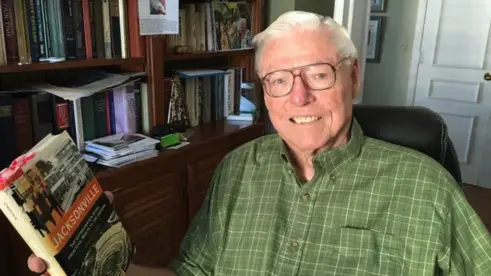
For each book, Crooks chose as his chronological point of beginning a significant event in Jacksonville’s past. The first was of course the Great Fire of May 3, 1901, and the second was the consolidation of its city and county governments, which became official on October 1, 1968. Both were pivotally defining moments in the now 203 years of Jacksonville’s existence. Both books insightfully unpacked the meaning of their events, while highlighting some of the people who experienced them. With both projects, Dr. Crooks conducted extensive research across the Greater Jacksonville community and formed lasting relationships with interesting Jacksonvillians outside the academy.
Jim’s books on Jacksonville had admirers as well as critics. Some believed that in both narratives, he focused too much on race, while others objected that he failed to account sufficiently for its influence on modern Jacksonville. Both criticisms have legitimate arguments to support them, rising out of what the readers themselves judge to be important. But no one can claim to have studied Jacksonville seriously unless they have read Crooks, recognized the depth of his research and are prepared to challenge or defend his interpretations.
After The Fire described Jacksonville as a “New South” city, referring to the region of the former Confederacy coming to terms with the wrenching changes resulting from the end of slavery and the changing politics of the American South. To Jim Crooks, Jacksonville navigated the Progressive era too cautiously, which set the stage for the racial tensions that erupted in the decades of the 1950s and 1960s, the climactic years of the modern Civil Rights Movement, which figure in The Consolidation Story. Crooks himself was deeply influenced by his presence at the August 1963 March on Washington, where he heard Dr. Martin Luther King deliver his landmark speech.
Dr. Crooks aimed toward telling stories about Jacksonville that would, more or less, yield a holistic view of its development. At the University of North Florida, he created and for many years taught a course on American Cities and Suburbs. In his research, teaching and writing, though, he was always drawn to political events and figures, and he was always concerned with social justice. The plain truth is that it is impossible to tell the story of any American city since the beginning of the 20th century without considering the impact of racial change and conflict.
Jim Crooks was a professional colleague who became a good friend. Since our first meeting 19 years ago, in my tiny History Department office at UNF, we met periodically for lunch and conversations that always turned to Jacksonville, past, present and future. While our interests overlapped, our interpretations of the past differed at times, as those of historians often do. But any disagreement with Jim was always thoughtful and respectful of differences, characteristic of the man.
A matter on which Jim Crooks and I firmly agreed was that Jacksonville’s history deserves a great deal more attention. Even just considering the 20th century, which was the focus of his two books, a gap exists during which Jacksonville experienced the Roaring Twenties, Prohibition, the Florida real-estate boom and crash, the Great Depression, World War II and the birth of the American Sunbelt phenomenon. Each of those events had effects that continue to reach out from the past and affect our lives in 21st century Jacksonville. Making sense of those effects is the work of history, and Jim Crooks did his part. At his death, he left plenty of honest work for the rest of us to do in historicizing this complicated, endlessly interesting city. He also left his research files, an imposing collection now preserved for future historians, here at the Jacksonville History Center. Thank you for everything, Professor!
Alan J. Bliss, Ph.D. | CEO, The Jacksonville History Center