

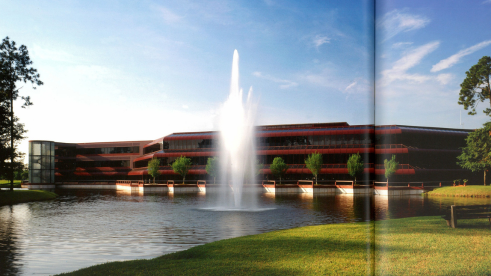
The life cycle of any building begins during construction and ends when it is destroyed or demolished. Until then, buildings go through changes in ownership, use or physical shape. Left on their own they deteriorate with age, but maintenance and renovations can extend their lives indefinitely, allowing them to serve new functions. Sometimes a building may be in great condition – well-built and well maintained but still unsuited to the best use for the location. When a building can no longer be repurposed, it is obsolete. Money can sometimes cure physical or functional obsolescence, but when no new use is economically sustainable, the cycle ends and begins again.
In the coming weeks, those factors will result in the demolition of a 43-year-old building on Jacksonville’s Southside, at 8000 Baymeadows Way. In 1983, it was the brand new, purpose-built headquarters of American Transtech, on 28 acres with over 450,000 square feet of floor space. The design was state of the art, including sophisticated capacity for computer cabling and an attached 100,000-square-foot building just to house a mainframe computer. The architect and contractor was Jacksonville’s Haskell Company, and the project was at the time the largest and most ambitious in the company’s history.
Even though Transtech was big, size was only a part of what made it so ambitious. Haskell had already proven that it could deliver large, complicated projects on time and on budget, a record that had been winning major corporate customers for the firm across the U.S. Transtech’s real challenge was the amount of time allowed for it to be designed, permitted, built, inspected and delivered to the customer. On September 9, 1982, representatives of the owner, a mysterious, unnamed Fortune 500 company, handed over a two-page memo broadly outlining their requirements, one of which was absolutely inflexible: the project had to be delivered by August 31 of 1983, just eleven months away.
The customer turned out to be the telecommunications giant American Telephone and Telegraph (AT&T), which had just been ordered by a federal judge to spin off its network of smaller telephone companies, such as Southern Bell. Because AT&T stock was publicly traded, an unprecedented program of stock transactions would have to be carried out by a certain date. That explained the delivery deadline for AT&T’s new facility. It was also the reason for one of its distinctive requirements, a massive computer room.
Transtech transformed Haskell’s 20th century history of growth. American Transtech was the largest project the company had yet undertaken, it required features with which the company lacked experience, and the schedule from concept to completion would require a ruthlessly crushing pace. However, Haskell had for years already been strengthening its distinctive “design-build” delivery method, in which every function of construction from architecture to fabrication was in the hands of one company. If anything went wrong, there could be no finger pointing between firms, and the customer would have no trouble identifying the responsible party.
Haskell’s head of architecture and engineering, John Zona, gathered a team that included Dave Engdahl as project architect. The group began preparing on Thursday for a presentation to the mystery customer. For two nights and three days, the team practically lived in a conference room, preparing to show the customer not just what they would do, but how they would do it on schedule, by August 31 of the following year. According to Engdahl, the project team’s motto came to be, “There is no September first!”
Once Transtech became convinced, the project kicked-off immediately, and the company worked virtually non-stop. Team meetings took place every Sunday morning, at 7 a.m. – the most opportune day and hour to get everyone together. Engdahl, the lead architect, recalls it as “probably the pinnacle of my career in architecture…it really brought the architects, the engineers and the construction staff together. We worked in lockstep. I spent about six months, pretty much living out on the job site. It was 24/7.” Haskell’s own steel fabricating division was also deeply engaged. If on Sunday morning a beam didn’t fit exactly right, it went back to the steel shop, which replaced it with one that did.
The Transtech project, completed on time with a celebratory dinner held at the jobsite, transformed Haskell in several ways. It stabilized the company financially during a period of economic uncertainty. It drove the teams to pull together and perform as they never had before, producing interior, exterior, and landscaping designs, plus systems such as a backup generator for the computer facility. It proved that Haskell’s people could deliver on a deadline that sometimes seemed impossible. “It changed the psychology of what we could accomplish,” Engdahl said. “We had to all cooperate to make that happen.”
The Transtech facility was followed by a surge of similar projects. Three years later, in 1986, Haskell designed, built, and occupied its own new three-story office building on the bank of the St. Johns River, in style and sophistication often compared to a graceful ocean liner. Now however, that handsome building may also give way to a new and very different use.
Now, at 43 years old, the Transtech building faces demolition, and will give way to the newest economically sustainable use for the property, which is to be warehouses. This is how healthy cities evolve. We advocate for preservation where it makes sense, but we do not treat buildings as museums. They are the site of events and represent the stories of people, and those stories include the reason for their original location, design and construction. Every building has a story of its own.
Alan J. Bliss, Ph.D. | CEO, Jacksonville History Center