

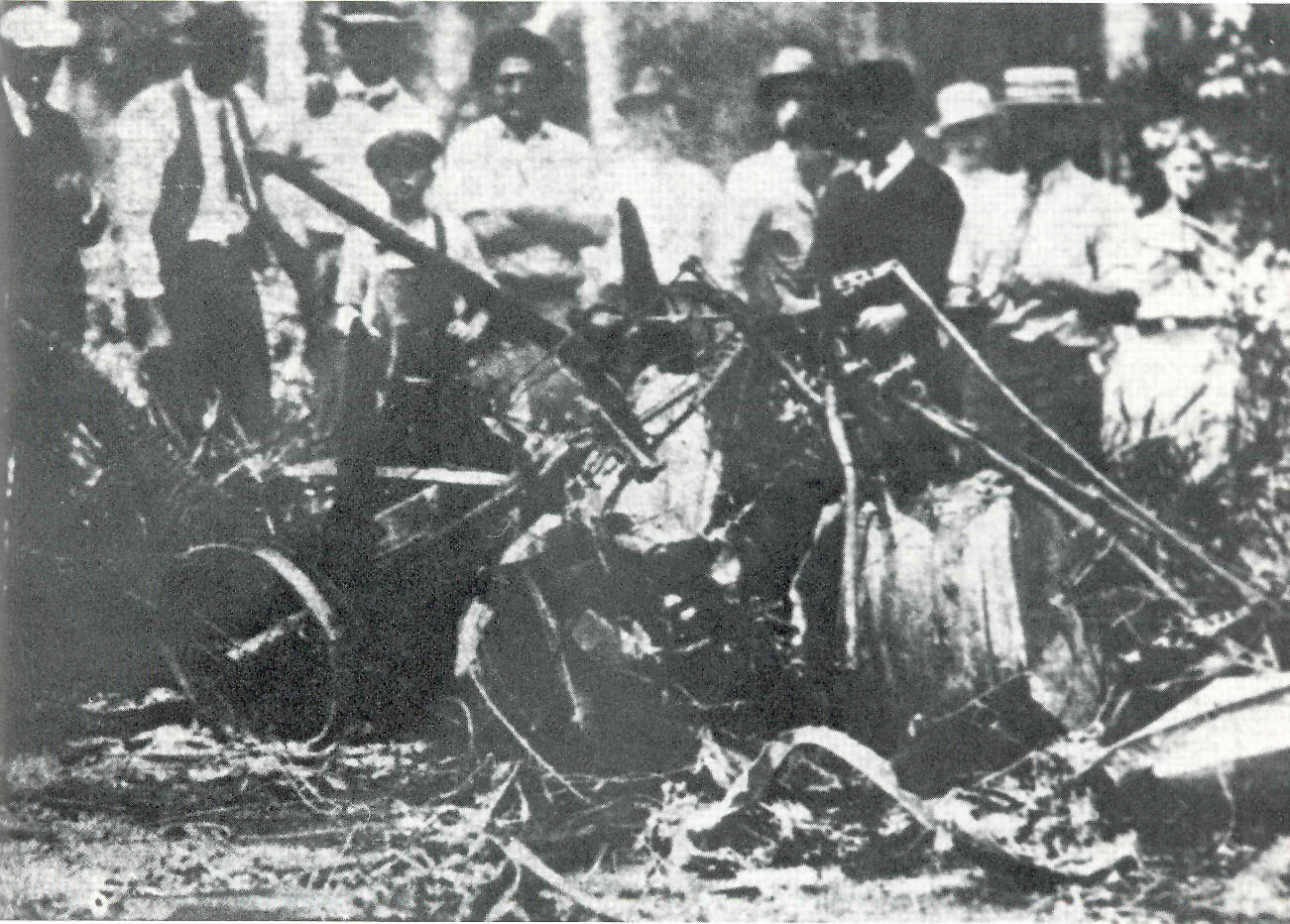
On April 30, 1926, the danger and drama of human flight came to Jacksonville in the person of Miss Bessie Coleman (1892-1926), a pioneering woman aviator, or aviatrix as they were then known. Exhibition flying was the polite term for “barnstorming,” a cottage industry that sprang up before the Great War and spread widely during the Roaring Twenties. Flying exhibitions attracted audiences wherever they took place, with people drawn by the prospect of watching daredevils defying gravity and sometimes losing. Flying was glamorous partly because it was novel, and partly because it was risky. The prospect of sudden, violent death made the experience impossible to ignore. People looked up reflexively at the mere sound of a passing airplane. When that plane was being flown for entertainment, it made for an irresistible spectacle.
Miss Coleman, a native of Chicago, was hardly the first American woman aviator, but everything we know about her points to a young woman with a powerful sense of herself. Setting aside her gender for a moment, she was part of the second generation of flyers in a time when merely taking off in an airplane was filled with risk. It was not until the middle of the 20th century that air travel began to gain a reputation as a reliable method of public conveyance. In the 1920s, commercial air travel was noisy, uncomfortable, and fabulously expensive, and quite obviously dangerous. Aviation accidents tended to be fatal, and dramatically so. That was why air shows or even individual stunt pilots attracted spectators who came prepared to witness mayhem and death.
Bessie Coleman was among the rare women who joined a decidedly, nearly exclusively masculine culture. Risk-taking is famously appealing among young males who enjoy health and capacities like good eyesight, coordination and endurance, all yet to be tempered by experience or consequences. A sense of near immortality fuels tolerance for risk, a thirst for adventure and a fascination with discovering boundaries. Taking a chance and getting away with it lends confidence and encourages taking more chances. The early years of flying had all those ingredients, and fostered a culture of daring. The suddenness and unforgiving finality of airplane crashes weeded out the reckless, while rewarding those who combined genuine skill with a bit of luck. A wisecrack in the profession was to the effect that “there are old pilots, and there are bold pilots, but there are no old bold pilots.” Women such as Bessie Colemen, or her more famous contemporary Amelia Earhart (1897-1937), seeking to join the community of early aviators, would have had to navigate more than just the inherent dangers of flying. For them to gain respect would have required taking and surviving extra risks.
Into that rarified society of airborne adventurers, Bessie Coleman entered not only as a woman but a person of color. The years of the Roaring Twenties were characterized not just by stock market gambling, Prohibition and new technologies such as radio, talking pictures and airplanes. The 1920s also witnessed a surge in violence directed at American Blacks, with five lynchings within Duval County alone. Nevertheless, Coleman made her very public way as a young African-American woman among mostly white males. Her determination and persistence must have been formidable, and her confidence in herself took her far. As a successful exhibition pilot, she eventually came to Jacksonville, where her adventures ended near the site of Paxon Airfield, from which her plane had taken off. William Wills was the pilot who was flying the airplane while Bessie was in the rear seat becoming familiar with the layout of the airfield. Bessie’s death certificate lists her occupation as “Aviatrix,” and confirms her death was caused by accident when she fell to earth, having been thrown from the plane when the elevator controls jammed. Local pilot Laurie Yonge inspected the wreckage and found that Wills had apparently left a wrench in the tail of the airplane.
Bessie Coleman and her pilot, who was white, were the first to die in an aircraft accident in Jacksonville. In 2016, the Durkeeville Historical Society placed an historic site marker near the crash site, at 2142 Melson Avenue, in front of Hammond Park in Jacksonville’s Allendale neighborhood. On June 15, 1921, Coleman had received her license from the Fédération Aéronautique Internationale, making her the first person of color, male or female, to hold a pilot’s license from a recognized credentialing organization. She was also the first native American with that distinction, as her father’s grandparents were members of the Cherokee Nation. Her visit to Jacksonville, brief and tragic as it was, connects us to stories reaching far across time and distance a century after her death.


Alan J. Bliss, Ph.D. | CEO, Jacksonville History Center