

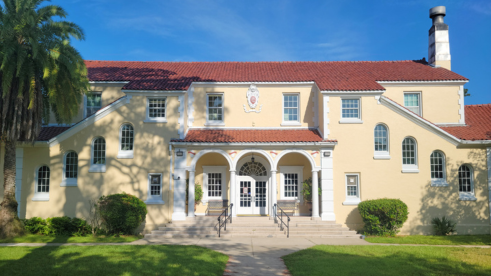
Being “true to your school,” as the Beach Boys sang on their 1963 album “Little Deuce Coupe,” became a pop anthem because it spoke to a near-universal experience for Americans. Whether we attended public or private schools, our years inhabiting their classrooms, hallways, cafeterias and gyms were the most formative of our lives. Schools are where most children begin to develop enduring relationships outside their immediate family. That’s where we learn the lessons in the curricula and take in the less formal lessons of navigating relationships. If we’re lucky, some of those relationships may carry us through a lifetime.
That helps explain why every school is meaningful to those who have experienced it. That is why schools are such powerful symbols of place and community, and it’s why they are part of our identity as individuals. One of the standards by which we assess the preservation value of any old building is, “Does it help tell a meaningful story about the past?” By any measure, schools answer that question with a “Yes.”
However, aging schools (especially public schools) are in trouble, here in Jacksonville and nationwide. According to the National Center for Education Statistics, school districts across the U.S. closed more than 1,000 schools in 2025-26. Districts in Houston Texas, Philadelphia and Pittsburgh in Pennsylvania and Broward County here in Florida plan more closings next year.
The reasons are several, staring with demographics. Declining American birth rates mean shrinking student populations. Throughout the 20th century, but especially during the baby-boom decades of the 1940s through the 1960s, school districts across the United States added classroom space to accommodate new enrollment. A wave of new school construction followed the demographic curve. New high schools appeared, and older high schools became middle schools. Former middle schools turned into elementary schools, and new elementary schools popped up across suburban neighborhoods. All of those schools, in high demand when they were new, are now getting old, even as they are serving fewer students.
Those trends are now combining to challenge local school districts such as Duval’s. Declining enrollment due to fewer children means there is too much school capacity. On top of that, declining enrollment means fewer dollars are available with which to manage and maintain schools whose maintenance needs are increasing. Shrinking budgets, excess capacity and growing costs all point to one conclusion, which is to decommission certain schools.
Facing up to that difficult conclusion brings up another challenge, which is obsolescence. Schools built during the 1920s, when America’s urban population abruptly soared, are now a century old. Schools built during the Cold War era for the baby boom generation are now approaching sixty- and seventy-plus years of service – designed for functions that have drastically changed, and past the point at which any building requires significant modernization.
Old neighborhood schools are increasingly obsolete, functionally and economically, and hard to physically adapt to the 21st century. But any school, public or private, that has been around since the glory years of public education’s growth has by now become a beloved institution, in its neighborhood, its community and in the hearts of its former students. It’s easy to understand the passion that drives neighborhoods and alums to fight the possibility of closing “their” schools. The frequency of such fights will grow, however. Enrollments keep declining, and the costs to operate schools keep rising.
School boards simply cannot keep all their beloved old schools in service. Preservation advocates and people who care about their school buildings have to get ready with more ideas. In the years ahead, we will be devoting more thought, effort and resources toward figuring out sustainable new uses for schools like Ortega Elementary, Kings Trail Elementary, and many others. The Jacksonville History Center continues to research models of adaptive reuse for aging school buildings and campuses, because they help tell important stories about Jacksonville. That kind of authentic engagement is part of why there is a Jacksonville History Center.
Alan J. Bliss, Ph.D. | CEO, Jacksonville History Center