

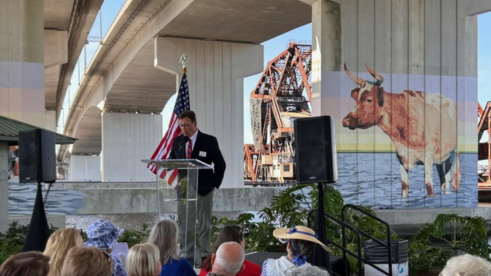
Two hundred fifty years ago, what we now know as Jacksonville was not Jacksonville, and the people who lived here kept their distance from the new, nascent, dangerous American Revolution. Florida remained English territory throughout the Revolutionary War. Just 13 years previously it had been part of the Spanish colonies, and seven years later, it reverted once again to Spain. Living here in 1776 might well have necessitated being bilingual, in Spanish and English. Then, as now, Florida and the place we now call Jacksonville were demographically and politically complicated.
The St. Johns River was then and remains the single most influential feature defining this place. But in 1776, it was far wider and shallower than today. It moved lazily through the narrower stretch that is now surrounded by downtown. Today the river’s depth reaches 70 feet or more at the Main Street Bridge. Two hundred fifty years ago at that point on the river, the best evidence is that depths were no more than around 16 feet. The banks of the river on both sides were gradual slopes that extended further out in both directions from the center of the channel. The concrete bulkheads that line today’s riverbanks were nonexistent, and the point at which they stand was several hundred feet away from dry land. That helps explain how it was feasible for cattle drivers to wade and swim cows across the river here, where such a practice would today be far too dangerous. It also explains why the river current races through the downtown section, as water always does when forced into a narrow channel.
Today, those cattle drivers and the folks who lived along this river calling it Cowford would find everything about this place wildly unrecognizable. The changes we have made to the river reflect immense changes to its surroundings over these past two-and-a-half centuries. Considering the effects we have had on this place and on the St. Johns River should move us all to be mindful of our stewardship responsibility in the present. The 21st century river, and the modern city through which it flows now belong to us, and we belong to them. In glancing at the past, let’s keep Jacksonville’s future in mind, and imagine how our legacy can be sustainable for all those who will come after us.
Alan J. Bliss, Ph.D. | CEO, Jacksonville History Center