

The celebration of America’s 250 years is called its 250th semiquincentennial, which is one half of 500 years. Or you could call it the 250th sestercentennial, meaning two and a half centuries. You might want to call it a quarter-millennial, which is one fourth of a thousand years. That really sounds old! But whatever you call it, what better way to celebrate this mighty milestone than to recognize our patriots and all military.
Telling the story of the James E. Merrill House Museum is a historical journey, from the building of the Merrill family house in 1879 to its restoration in 2005. The Merrill family history shows both Mr. and Mrs. Merrill had a deep love of history. James Merrill belonged to the Florida Historical Society and Helen Merrill traced her family lineage to relatives who fought in the Revolutionary War and many other wars.
Elisha Small (1756-1844) served as a private, corporal and sergeant, Massachusetts line. In 1840, he was a pensioner in Maine. Jeduthan Upton (1752-1823) was placed on the pension roll of Maine in 1818 for service as a private, Massachusetts line.
Captain Jesse Smith, Jr., was a veteran of General George Washington’s Commander-in-Chief’s Guards, known as the Life Guards, an elite corps of 50 to 200 soldiers selected from all the colonies and charged with protecting the life of General Washington. They took part in major Revolutionary War battles under Washington’s command. At the time of his death in 1844, Smith was one of the “last survivors” of the unit.
In 1775, Smith belonged to a company of Minutemen and participated in an alarm call in the running fight from Concord to Cambridge. On April 21, 1775, he enlisted for eight months and participated in the Battle of Bunker Hill. When his enlistment ran out, he re-enlisted into the Continental Army and was drafted into Washington’s First Foot Guards. In 1776, he re-enlisted in Washington’s First Horse Guards. He had served at White Plains, Brandywine, Germantown, Monmouth and Valley Forge. He left the army before the war’s end and went to Salem, Massachusetts, and served on a privateer. He was captured and served the rest of the war in Mill Prison. In civilian life, he became a shipmaster. On his monument is inscribed, “He was the last survivor of the body-guard of Washington.”
Tracing her lineage through Small, Upton and Smith, Helen Merrill was accepted to the Daughters of the American Revolution and to the Daughters of 1812.
In researching my own family history in 1980, I discovered my 5th great-grandfather, Oliver Bell, who was born in 1752 in Connecticut. While living in Tinmouth, Vermont, he served as a private in the Vermont troops in 1775, serving in Salem, New York. He served under such men as Lieutenant Stephen Allen, Major Stephen Rice, Colonel Warner, Ebenezer Allen, until December 1782, for about eight months. He also served in a Connecticut Regiment.
During my research, a man named Clark Bell reached out to me. He was also related to Oliver Bell and had researched him for years. In 2002, Clark Bell was a photographer for the “Saratogian” newspaper staff in Saratoga Springs, New York. From his research, he shared the following information.
“TICONDEROGA – Saratogian photographer Clark Bell is proud of the horse thief in his family. His great-great-great-grandfather, Oliver Bell, stole those horses.”
Oliver Bell, 1752-1939, was in a company of Vermont militia assigned to Fort Ticonderoga under American Gen. Arthur St. Clair. In 1777, he arrived with other reinforcements from New England. The British arrived soon after. Oliver helped the American Army to some British livestock, an incident mentioned – in the third person – in the pension files.
“On a day when the horses were feeding on the common, guards stationed about, two of them, while feeding, ranged a little out of the common field, which he discovered and took advantage of etc. (sic) and undiscovered by the guard until there was some distance between them and the main body of horses, he then drove them into the fort.”
The British had guns on Mount Defiance, though, and St. Clair evacuated the fort.
Oliver Bell moved to Constable, New York, in 1811.
He and his two sons, Freeman and Samuel, built a frame house, sixteen by forty feet, with a wing, and kept a hotel/tavern in a clearing of an acre and a half. In the War of 1812, this house was the headquarters of the commandants of the American troops and also British officers after the evacuation of forces.
In 1908, this house caught fire and lost was the old sign, “F. Bell’s Inn,” which swung for many years from a post in front of the building, inviting immigrants to rest and refreshments within.
Oliver’s sons, Freeman and Samuel, fought during the War of 1812.
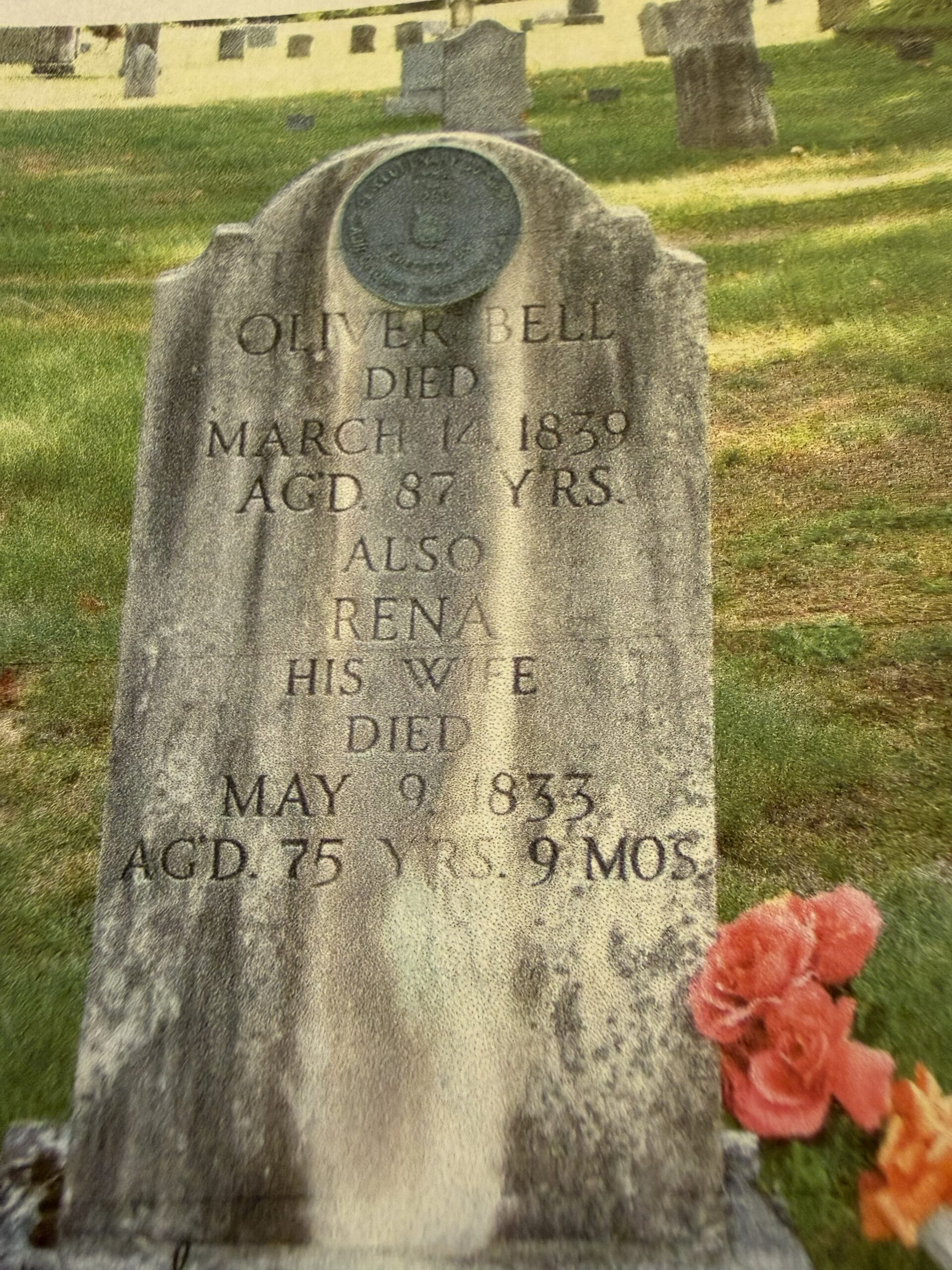
On Oliver Bell’s gravestone, 1752-1839, is embedded a bronze disk stating: Revolutionary Soldier 1775-1783 – Erected by the Adirondack Chapter D.A.R.
Knowing firsthand about some of the patriots who fought for this country makes it even more exciting to celebrate America’s 250th birthday, as well as Elisha Small, Jeduthan Upton, Jesse Smith, Jr., and Oliver Bell, and all who fought for independence.
Nancy Gandy | Merrill House Museum Coordinator